








Significance of the Research
Entry, Descent, Landing, and Recovery (EDL&R) technologies are one of JAXA’s core competencies, and maintaining and further enhancing their high level of international competitiveness is essential. However, atmospheric-entry missions at JAXA are relatively infrequent, which makes it challenging to steadily inherit and advance these technologies. At the same time, system requirements have grown increasingly complex and diverse in recent years, and the number of technical challenges to be addressed has continued to grow.
Research Objectives
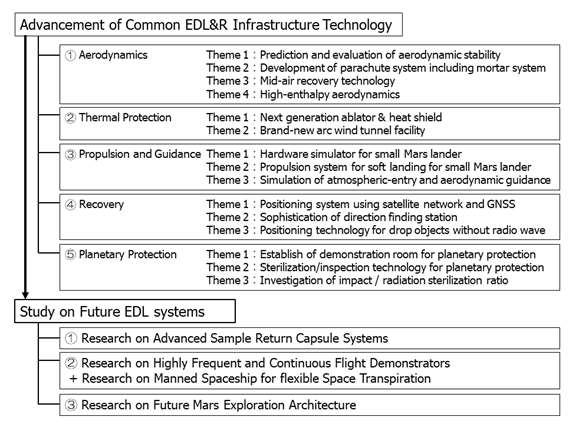
As shown in Figure 1, this research comprises two main components: (1) the advancement of common infrastructure technologies, spanning 15 technical themes across five domains; and (2) studies of future EDL systems, primarily related to three space exploration missions. The objectives of each research theme are outlined below.
Advancement of Common EDL&R Infrastructure Technologies
Drawing on the Basic Plan on Space Policy, the Global Exploration Roadmap, and roadmaps for space science and exploration, this research advances 15 key EDL&R foundational technologies across five domains (top section of Figure 1). These technologies are essential for supporting current and future EDL&R missions and for enabling the creation of new, value-added space missions. Each research topic aims to achieve its respective technical goals.
Figure 2 presents examples of activities conducted to date, including tests carried out in each domain.
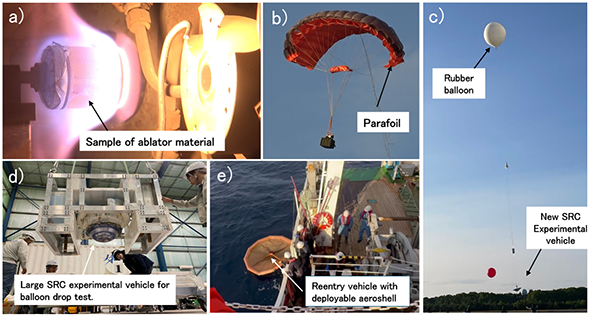
- Heating tests of next-generation ablative materials in an arc wind tunnel
- Drop tests of parafoils for aerial capture of re-entry capsules
- Drop tests from rubber balloons to evaluate the aerodynamic stability of new capsule designs (shown at balloon launch)
- SRC experimental vehicle for large-sample-return-capsule free-flight and parachute-deployment tests using high-altitude scientific balloons in Australia
- Sea recovery operations of the RATS-L atmospheric re-entry and recovery demonstrator using a sounding rocket
Research on Advanced Sample Return Capsule (SRC) Systems
To acquire advanced sample return capsule (SRC) technologies, system design studies use the SRC of the CAESAR mission—a joint proposal with the United States for a comet sample return mission—as a reference model (Figure 3, top). A full-scale Breadboard Model (BBM) will be developed to demonstrate system feasibility.
The CAESAR SRC represents the most advanced concept currently envisioned for a sample return capsule. Critical technologies identified during preliminary studies (conceptual design) are being intensively addressed, and the results are fed back into the system design. The technologies acquired through this effort will be applied to advanced SRC systems (Figure 3, bottom) for the next-generation deep-space sample return missions under consideration in Japan.
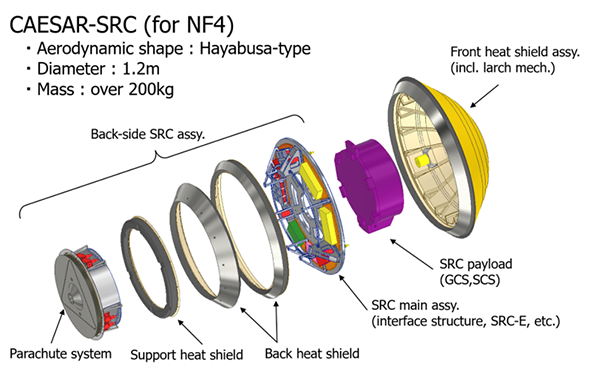
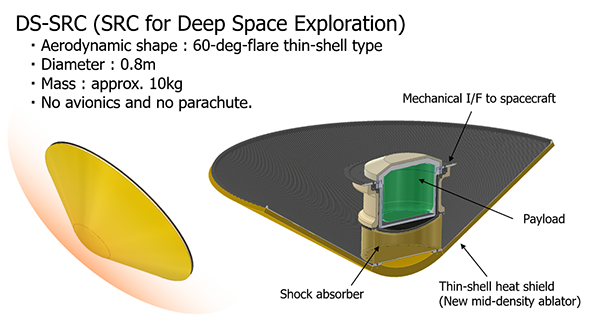
(Top: Large SRC for CAESAR; Bottom: High-speed re-entry SRC for next-generation small-body sample return missions)
Studies on High-Frequency, Continuous Flight Demonstration Vehicles
Building on the system design technologies for re-entry and recovery capsules developed through the HTV-mounted Small Re-entry Capsule (HSRC), this research aims to establish a high-frequency, continuous sample return system that supports expanded utilization of low Earth orbit, including the International Space Station.
Two capsule concepts are under consideration as candidates for such systems (Figure 4). For the “high-frequency sample return capsule utilizing a base platform,” JAXA is co-creating concepts in collaboration with private companies planning commercial high-frequency sample return services from low Earth orbit, with the goal of early realization.
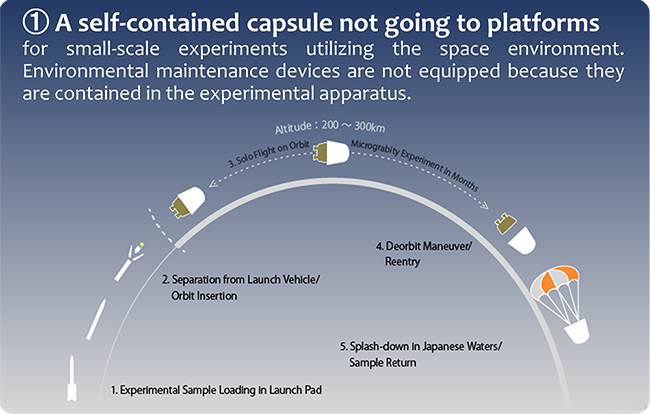
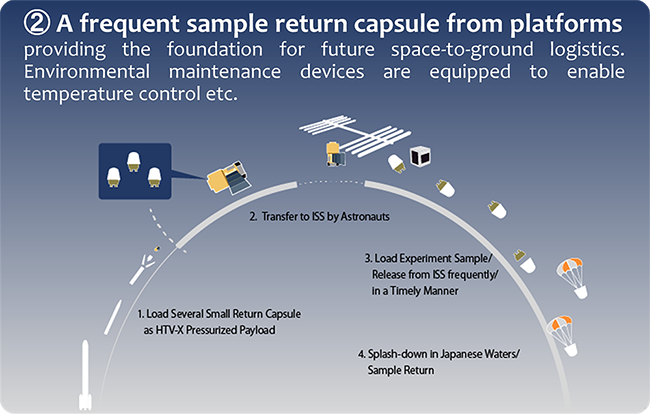
(Top: Self-contained capsule; Bottom: High-frequency recovery capsule utilizing an orbital platform)
Studies on Future Mars Exploration Architecture
As part of efforts to develop landing and ascent technologies for gravitational bodies outlined in the Space Policy implementation plan, this research advances studies of the architecture and key technologies for strategic Mars exploration following the MMX mission (JSMEP), based on the Global Exploration Roadmap and R&D strategies for advanced space exploration technologies.
A stepwise demonstration plan will be formulated to acquire the EDL technologies required for Mars landing. Based on this plan, trade-off studies and conceptual design of a Mars landing demonstrator (Figure 5) will be conducted, along with validation of critical technologies and system-level studies.
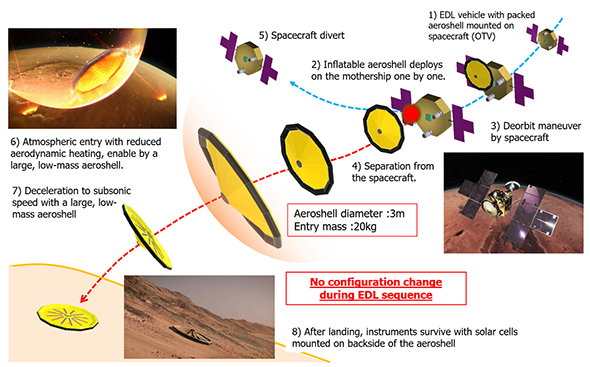
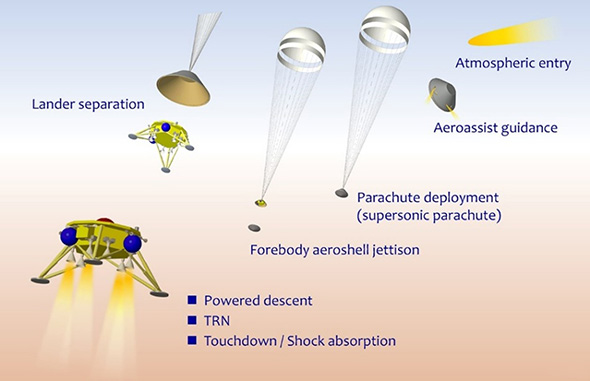
(Top: Ultra-small Mars lander using an inflatable aeroshell; Bottom: Demonstrator for retropropulsion and soft-landing technologies)