







Significance of the Research
SSPS offers the following advantages:
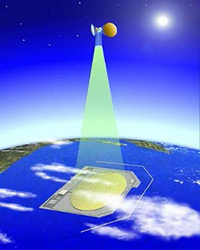
- Low carbon dioxide emissions and minimal exposure to fossil fuel price fluctuations.
- Access to solar radiation is about 1.4 times stronger than at Earth’s surface, providing a stable energy source largely unaffected by day–night cycles or weather.
- Flexible wireless delivery of power to where it is needed, reducing dependence on terrestrial power grids.
- Lower vulnerability to ground-based natural disasters such as earthquakes.
Realizing SSPS, however, requires overcoming many technical, safety, and economic challenges:
- Highly efficient and safe power generation, transmission, and reception
- Construction of large-scale space structures
- On-orbit operation, maintenance, and repair over the long term
- Mass, low-cost transportation to space
Research Objectives
Microwave Wireless Power Transmission Technology
R&D on the technologies essential for transmitting energy from space to Earth by microwaves, including high-efficiency power-to-microwave-to-power conversion and precise beam control.
Laser Wireless Power Transmission Technology
R&D on the technologies essential for transmitting energy by laser beams, including high-efficiency conversion and precise beam propagation control.
Large Space Structure Construction Technology
As a first step, R&D focused on establishing unmanned assembly technologies for structures ranging from tens to hundreds of meters in scale.
About the SSPS
Many studies have been conducted on SSPS concepts and technologies in Japan and overseas. The section summarizes the history, advantage, and challenges of the SSPS.
FAQ
Answers to the questions most frequently asked about the SSPS program.